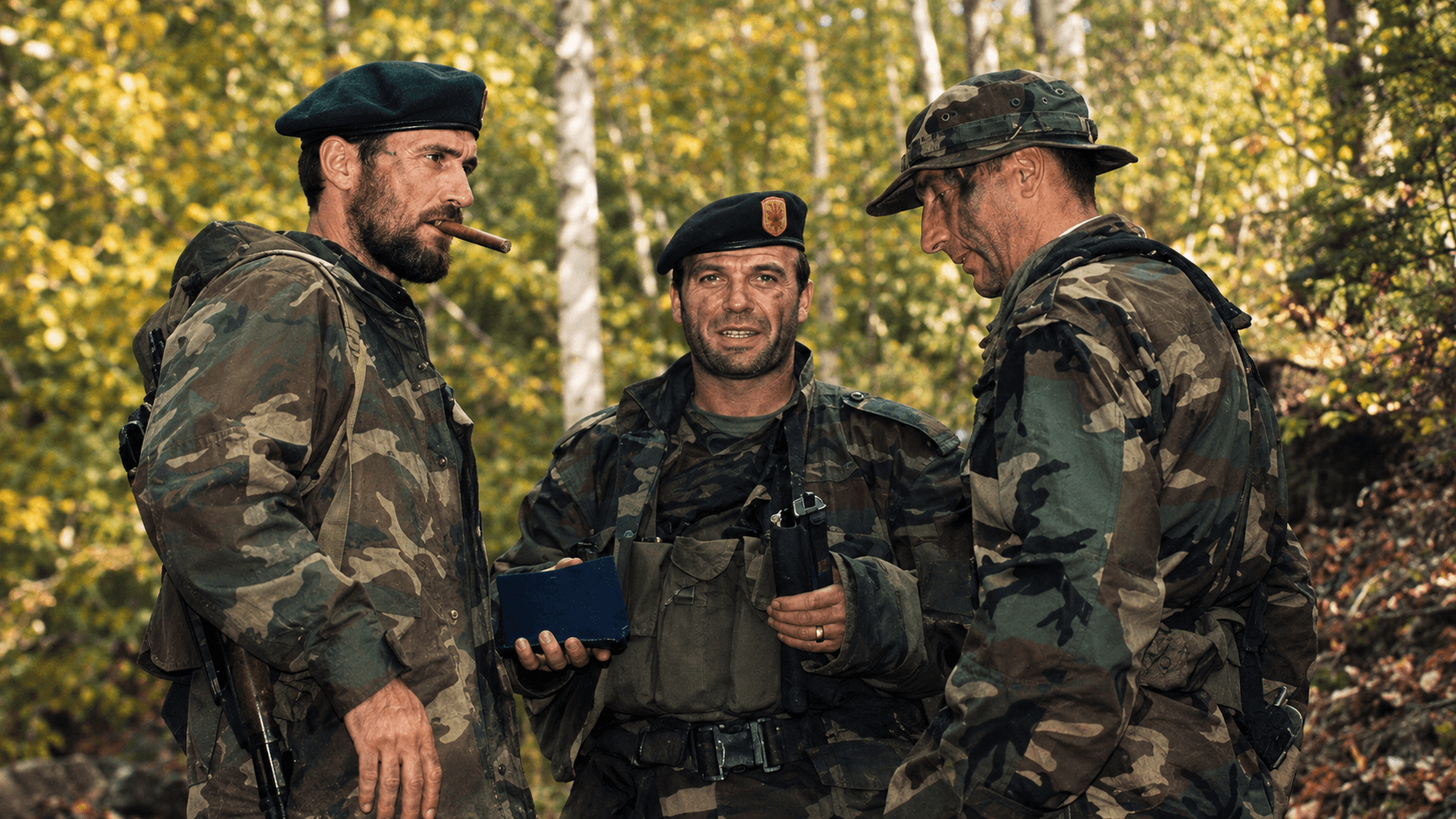
Koshare: The Battle That Broke the Border Between Albanians
On 9 April 1999, fighters of the Kosovo Liberation Army, led by the 138th Brigade "Agim Ramadani", broke the line that had divided Kosovo from Albania since 1913. It was a frontal battle planned from the first day to end in freedom.
On 9 April 1999 the 138th Brigade "Agim Ramadani" and fighters from almost every operational zone of the Kosovo Liberation Army broke the border between Kosovo and Albania. The line dated from 1913, respectively 1918, and it had cut Albanians off from one another for generations. The breakthrough opened the way for armaments and logistical support. The battle lasted two months, in extremely difficult conditions and with extraordinary determination. 114 fighters fell as martyrs, among them Agim Ramadani and Sali Cekaj, and over 400 were wounded. At least 108 soldiers and officers of the occupying Serbian army were killed. Volunteers from France, Algeria, Italy, Sweden and Britain fought in the KLA's ranks, while Mercenaries from Russia fought on the Serbian side.
The idea did not strike anyone overnight. Through 1998 the units had fought as guerrillas, with small formations, hit-and-run actions and constant pressure meant to exhaust the enemy. Then the capacities grew, and the time came for complex operations. The units needed a geographic space through which to receive new recruits, supplies and logistical support, and to evacuate the wounded. The plan worked on three levels. Strategically it was a frontal war for the final liberation of Kosovo. Operationally it would split the enemy forces on the Dugagjin plain in two by controlling the dominant features, the crossroads and the vital facilities. Tactically it would secure a corridor to Albania. The chosen ground was alpine, mountainous territory, where the Serbian side's heavy equipment would be dampened and its advantage reduced.
The foundations were laid in September 1998 at the training center in Papaj, where three units stood side by side. One was commanded by Rustem Berisha, with Agim Ramadani as chief of staff. Another was led by the hero Sali Cekaj. The third was the diversionary-reconnaissance battalion Kobra, commanded by Anton Cuni. Every evening at eight they held a briefing, analyzing the day's work, assigning the next day's tasks and asking how to strike the Serbian forces harder. Out of that routine came Operational Group Three, with Rustem Berisha in command, Agim Ramadani as chief of staff and every officer carrying double duties because cadres were so few. The attack order was drafted over days of observation and analysis, with information from the reconnaissance units. It was built on the doctrine that liberation wars begin at the border and end in freedom on the other side of it. Each commander knew his direction and his objective. Agim Ramadani used to say that military templates get broken on the battlefield, and the brigade improvised: horses and transport, mortars, anti-aircraft guns, and a command and logistics segment. Of some 3,000 members of the brigade, 16 were foreigners from the Scandinavian states, Benelux, Germany, Italy, Croatia and others. They went through the same training as everyone else.
The commanders speak with open eyes about what went unfulfilled. The general staff, through Jakup Krasniqi and Nasim Haradinaj, approved the frontal battle from the border and promised support. The support in personnel and armament came. The promised battalion of the best-prepared KLA boys, to strike the enemy's rear, never arrived. A second operation along another stretch of the border, promised for three days after the start, came one month and eighteen days late, at Pashtrik. They do not accuse. The intentions were good and the possibilities limited. On the ground, among those who fought, there was no tension. Fighters mobilized through the Ministry of Defense and fighters mobilized through the movement wore different uniforms until the moment they put them on, and after that there was no difference. Even the jokes crossed the lines, in a unit that had a man who kept a photograph of Enver Hoxha and a commander who laughed at the coded fire missions.
Koshare is the hardest memory for the other side. The Serbs call it Vietnam and the hell of Koshare, and they demand accountability for their losses. They cannot admit they were beaten by the KLA, so they claim they faced the Army of Albania, NATO, the foreign legion, the SAS and the Navy SEALs. That fiction is the measure of the blow. To call Koshare a shame or a great deception, as Dilaver Goxhaj did, is to put ourselves on a par with those who celebrate defeats. A visit after the war settled the question. Walking through the barracks at Junik, he saw the mine-clearing equipment, the tactical transport, the interception and electronic warfare gear, and the snowmobiles, and he raised no doubt at all about the brigade's success. The battle was unity in practice, across parties, across ranks and across nations. It opened the border and lit the first light of triumph of the war for freedom, independence and democracy. The price was paid by 114 martyrs, and the freedom and the state we are building are what they bought.