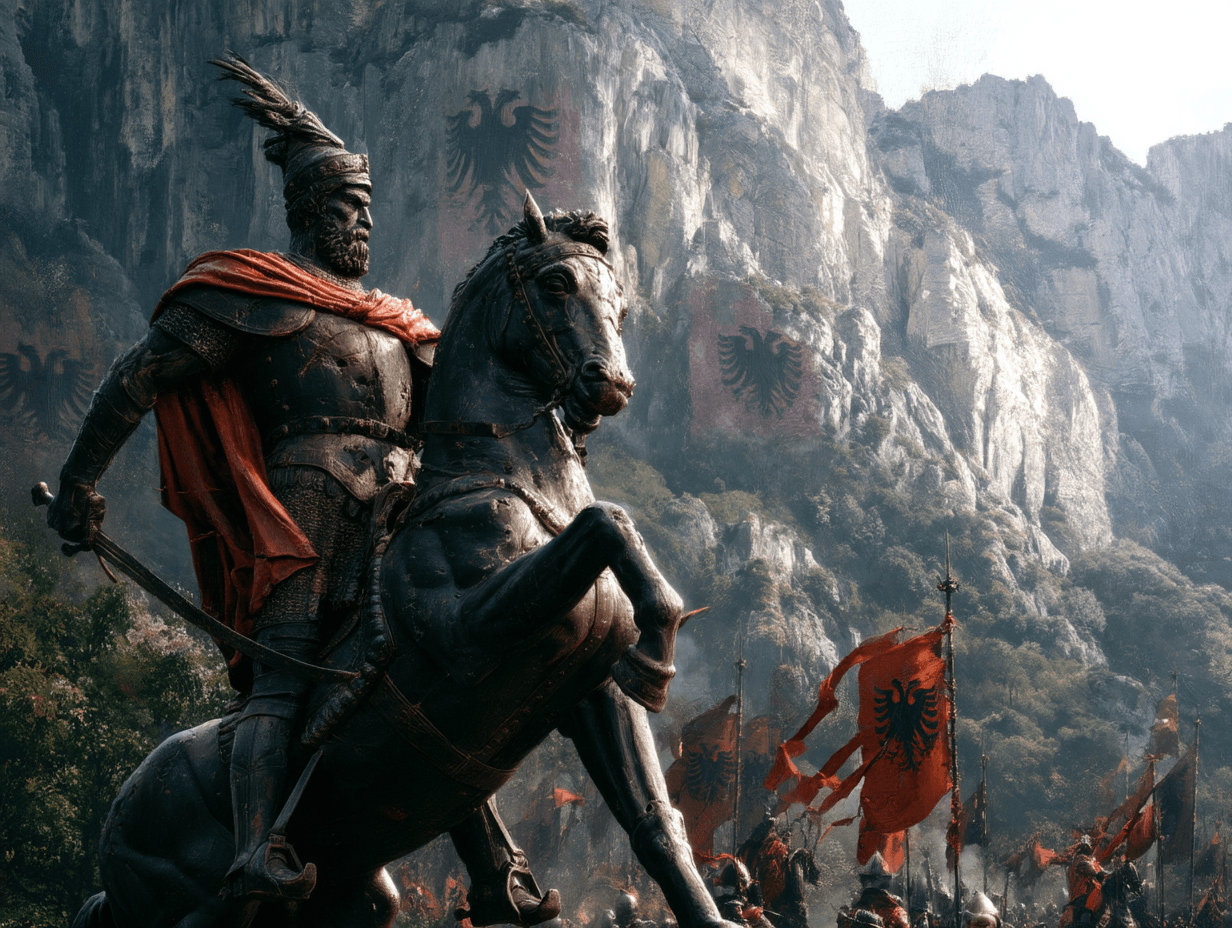
Skanderbeg: The Hero Who Saved Europe Twice
For 25 years, Gjergj Kastrioti Skanderbeg led Albanian forces against the Ottoman Empire, earning him recognition as a defender of European civilization. But his legend grew even more powerful after his death, inspiring centuries of writers, artists, and musicians across the continent.
Skanderbeg was born on May 6, 1405, as the youngest son of Gjon Kastrioti and Princess Vojsava. When his father was defeated by Sultan Murad II in 1421, young Gjergj was taken as a hostage to the Sultan's court in Adrianopolis. There, his intelligence and physical prowess earned him a place in the Sultan's school for training commanders and administrators. He received the name Iskënder—Alexander—and in time became known as Skanderbeg, meaning "Alexander the Prince" or "Alexander the Noble."
On November 3, 1443, Skanderbeg seized his opportunity for freedom. While leading Ottoman forces against Hungarian commander Janos Hunyadi near Nis, he orchestrated a stunning Ottoman defeat. Skanderbeg then turned his army around and marched home to Albania with 300 cavalry and his nephew Hamza Kastrioti. Using a forged document, he seized Krujë Castle on November 28, 1443, and declared the restoration of the Kastrioti principality. The black double-headed eagle banner was raised over the fortress as word of the uprising spread rapidly through Albania. Within December, central and northern Albania had been liberated from Ottoman control, and Skanderbeg was elected leader of the League of Lezhë, uniting the fractured Albanian princes for the first time.
For 25 years, Skanderbeg employed brilliant military strategy and tactics, understanding that victory could not depend on numbers alone. He kept the enemy in constant alarm, blocked their supply routes, and struck with sudden, powerful attacks. His reputation grew so fearsome that stories of his legendary strength circulated throughout the region—tales of his sword that allegedly required three men to lift, of his ability to shatter rocks and pierce mountains. Even Sultan Mehmed II, who took Constantinople but failed twice to capture Krujë's walls, became legendary for requesting Skanderbeg's sword as a gift. Skanderbeg reportedly sent it, then told the concerned Sultan he had surrendered his sword but not his arm.
On January 17, 1468, Skanderbeg died in Lezhë while convening a council of Albanian princes. He was remembered as the glorious leader who had guided his people for 25 years. His widow and son emigrated to Italy, as did part of the Albanian nobility. Yet Skanderbeg's death marked not an end but a transformation. Within decades, his figure began circulating throughout Europe in manuscripts, printed books, and artistic works. The first foreign authors to write about him were Serbian priests and former Janissaries in the 1480s, establishing a pattern that would continue for centuries.
Between 1504 and 1510, Marin Barleti's voluminous Historia of Skanderbeg was published in Rome, becoming the foundational text that spread Skanderbeg's legend across Europe. It was translated into German (1533), Italian (1554), Portuguese (1567), Polish (1569), French, Spanish, and English, each edition reaching new audiences. By the seventeenth century, Skanderbeg appeared in operas by Antonio Vivaldi (1718) and François Francœur, in poems by Michel de Montaigne and Pierre de Ronsard, and in tragic dramas on the stages of London and Paris. Voltaire wrote that the Byzantine Empire might have survived had it possessed a leader like Skanderbeg. The national hero of the Albanians had become the hero of all Europe.
Europeans revived Skanderbeg's figure repeatedly during moments of Ottoman threat, most notably in 1537 when Sultan Suleiman the Magnificent advanced toward Europe, and again during the Greek War of Independence in 1821. His image appeared in paintings, engravings, and sculptures by masters including Rembrandt, Gentile Bellini, and Ivan Meštrović. For centuries, from the Renaissance through the Enlightenment and beyond, Skanderbeg represented European resistance to Ottoman expansion and became an emblematic figure of European civilization itself. Geschichten Albanian writers and painters—including Naim Frashëri, Fan Noli, and others—brought him back to their own people during the Albanian National Renaissance, using his legend to inspire their own independence struggle. Skanderbeg thus saved Europe not only during his lifetime but also after his death, his myth providing hope and unity to a continent facing existential threats.