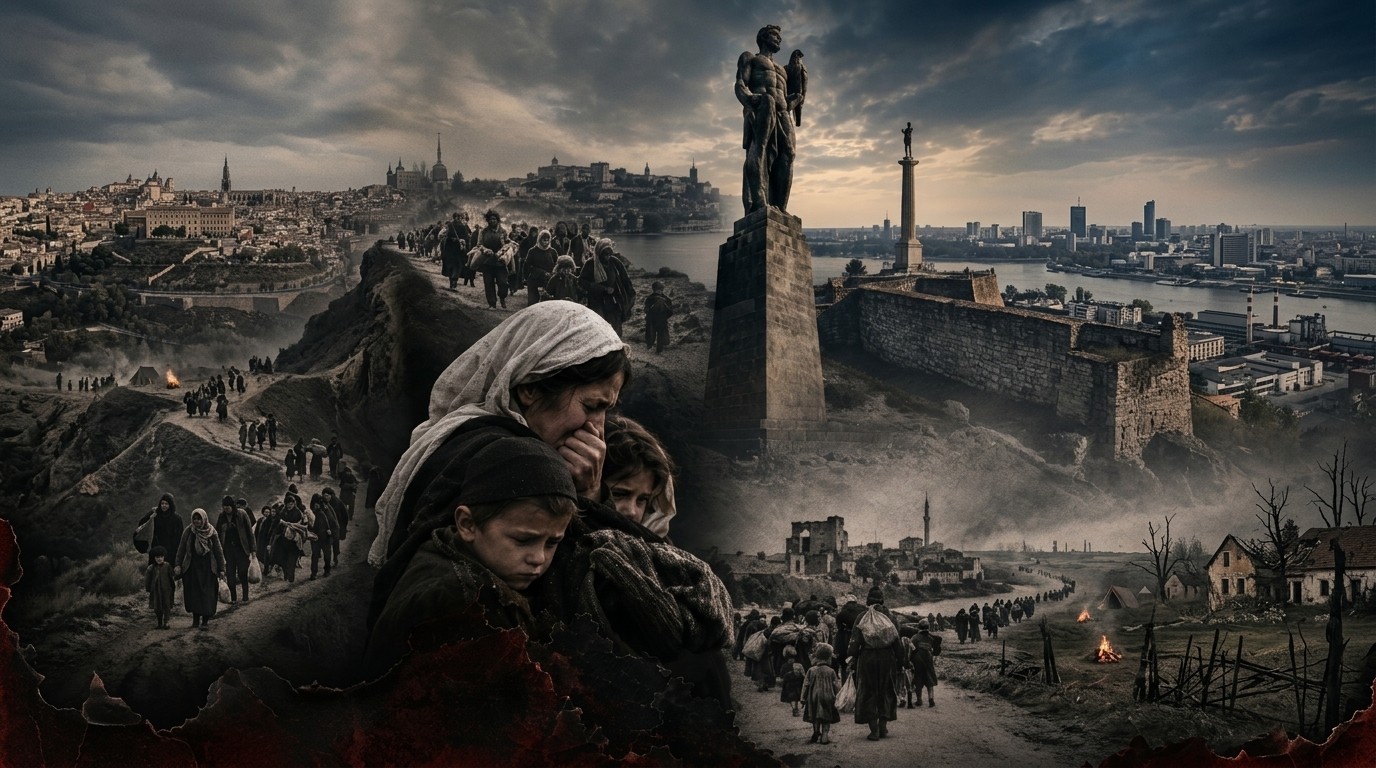
The Albanians of Belgrade: A Forgotten Chapter
Beneath the 14-meter Victor monument at Kalemegdan lies a story few visitors are told: the story of the Albanians who lived, worked and fought in Belgrade, and of how they were driven out and erased.
High above the Kalemegdan fortress stands Ivan Meštrović's Victor, a figure about 14 meters tall, raised as a monument to victory after the First World War. For years it has stirred debate in Serbia, because nothing in the figure ties it clearly to the Serbian war or to Serbian history. It is a strong man with a falcon, and its elements have raised questions that rest not on artistic taste but on documents and facts. Serbian authors themselves point not to ancient history but to the early 19th century.
That century opens with the First Serbian Uprising of 1804, remembered in Serbian history through Đorđe Petrović, Karađorđe, and the Karađorđević family. Belgrade then was not the great city of today. Since the 16th century it had passed back and forth between Ottomans and Austrians, a fortress on the border where the interests of great powers met. Under the Ottomans its population was largely Muslim, and among its Muslims were many Albanians. Albanian documents mention a street where a large mass of laborers from Albania lived.
Albanians were never only soldiers or Muslims in Belgrade. A good part of the Orthodox population came from Elbasan, Manastir, Janina and Shkup. Orthodox Albanians worked in trade and the arts, like the Zografi brothers, who painted church walls with inscriptions in Albanian, Greek, and later Serbian. There were Catholic Albanians too, and a Latin document from 1630 may even connect to Pjetër Bogdani. A book of the Serbian Academy of Sciences from 1972 to 1974, written by eminent scholars, carries statistics on Albanians in the city, and their presence echoes in the folk songs of Belgrade.
Then there is Jani Kondo, the Janissary known in Serbian sources as Konda Bimbaša, of Albanian origin. In the uprising he played a role in the capture of Belgrade in 1806, opening one of the city's gates to the Serb forces. For the Serbs he became a hero, and his story is told in Serbian sources. Albanian songs praise him as a figure of great reputation, while Vuk Karadžić presented part of Albanian folklore as Serbian. The scholar Vladimir Stojančević identifies Kondo as an Arbanas, an Albanian, and Aleksandar Pavlović discusses him in his 2019 book on the Albanian in Serbian culture. Yet tourists who gaze at the Victor today hear nothing of any Albanian connection, and Serbian historiography has been reluctant to acknowledge Albanian figures.
The decades that followed turned harsh. The Ottomans withdrew in stages, with Serbian autonomy recognized in 1830 and the garrisons leaving in 1867, and the Muslim share of Belgrade shrank as a politics built on Orthodoxy grew. In 1844 Ilija Garašanin produced the Načertanije, a platform of territorial expansion envisioning lands that today include Kosovo, northern Macedonia and northern Albania. Mass expulsions of Muslims, Albanians among them, struck Belgrade, Niš and Toplica around the wars of the 1870s, sending families to Anatolia, Bosnia, Bulgaria and Romania. Hundreds of buildings were destroyed and property was seized. Whether Karađorđević or Obrenović ruled, one thing did not change: the policy of expelling Albanians.
By the century's end very few Albanians remained, mostly poor, working as laborers or in trade. What survives are street names, Slavicized toponyms, and the folk memory of Jani Kondo. This history, tied to the later course of Serbian policy from 1877 and 1878 through the Balkan Wars to the massacres of 1999, is documented and cannot be denied. To study it is to understand the region, and to give it a stronger voice.