The Black Society for Salvation: Albania's Shadow Brotherhood
Its emblem bore a revolver, a dagger and a bomb, and its oath promised death to traitors. The Black Society for Salvation was the most secret and most enigmatic organization of the Albanian national movement.
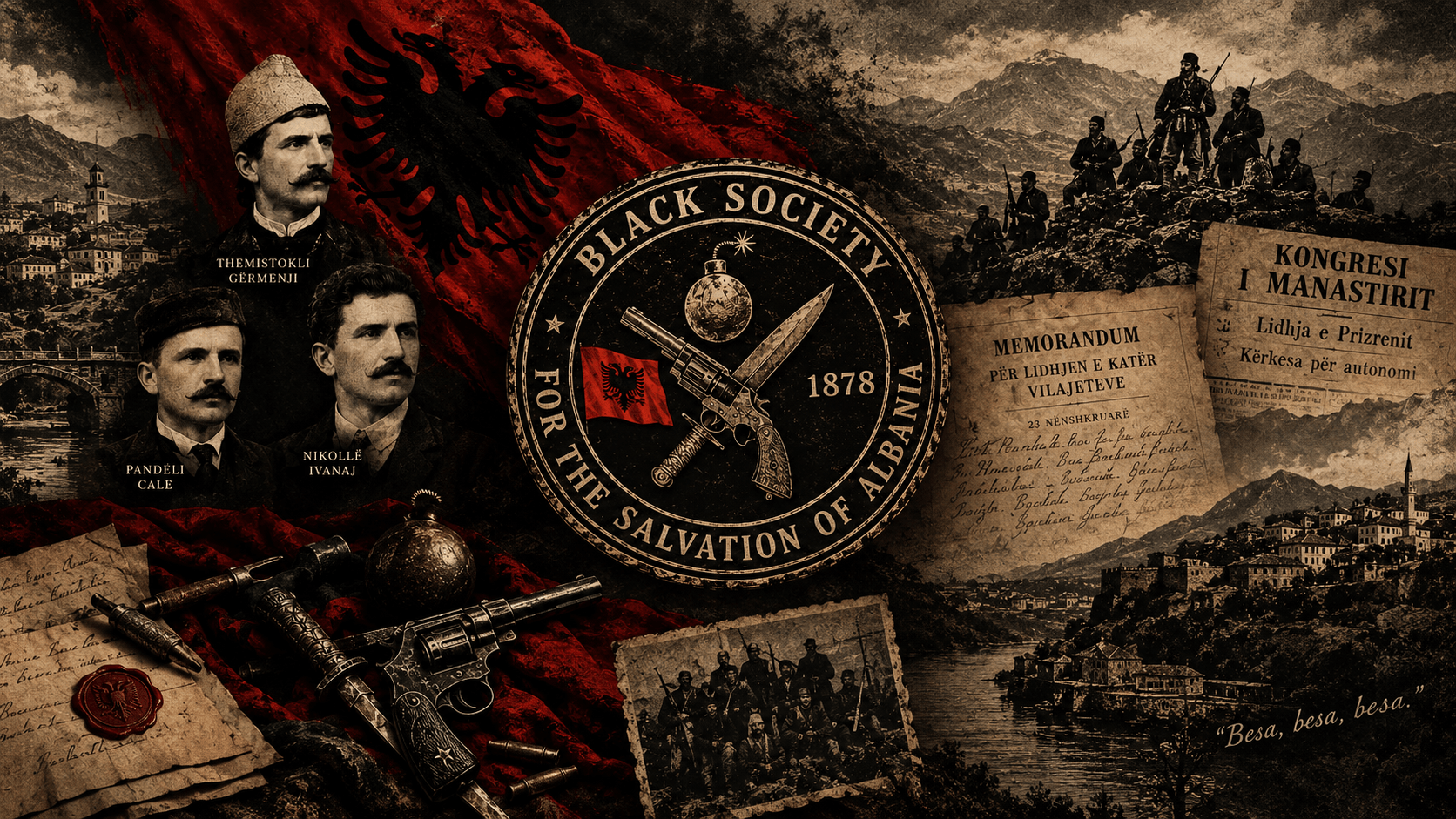
Few have heard of the Black Society for Salvation, and even historians know too little about it. Yet Albanian patriots founded it, and it was unlike any other. Uprisings and memoranda were not its only tools; at its core lay the organizing of assassinations, the execution of anti-national figures and of anyone who aided the occupiers. Its seal was circular, with the words "Black Society" above and "for the Salvation of Albania" below. At the center a revolver and a dagger were crossed, and above them sat a bomb. Its symbols were the Albanian flag and the year 1878, the founding of the League of Prizren.
It was born of betrayal. After the Young Turk revolution of the summer of 1908, Albanians hoped for rights and, in time, autonomy, and for a while they received congresses in Manastir and Elbasan and patriotic clubs. Then the concessions were reversed. In 1909 laws banned national bands, with the death penalty for fighters and those who sheltered them, and obstructed national associations. Xhavit Pasha led a punitive campaign in Kosovo and Lumë, massacring people and burning villages, while schools were closed and patriots arrested. In that year the Black Society took shape, with three main founders: Themistokli Gërmenji, the famed band leader of the south and southeast; Pandeli Cale, an emigrant from Romania who later signed the Declaration of Independence in Vlorë; and Nikollë Ivanaj, journalist, publisher and organizer of uprisings. Some researchers push its origins back to 1878 and name Thanas Gërmenji and Ilo Grameno, fathers of Themistokli and Mihal. No document confirms it, which is only natural for a secret organization.
Its oath was iron. "I swear by the name of God to serve Albania. If a traitor of the society emerges, this dagger and this revolver will pierce his heart." Members swore "besa, besa, besa," and none could reveal the secret or leave. The society's enemies were many: the Ottoman Empire, and the Greek, Bulgarian, Serbian and Macedonian bands. Treason meant death. Branches could not punish without orders from the center, except in the most urgent cases, with confirmation sought afterward. Members did not all know one another, so that if one part was struck, the rest could not be identified.
Its blows were real. In the summer of 1911, Ottoman troops killed six patriots of the bands of Spiro Bellkameni and Qamil Panariti at Orman Çiflik, near Korçë: Bajazit Reboha, Kostaq Kosturi, Kristaq Furxhi, Nuçi Api, Odise Kota and Tushi Kristofilaku. A year later Themistokli Gërmenji, Dali Përmeti and Vasil Tromara hunted down the commander held responsible, Rexhep Palla, and he was left dead. The photographer Thimi Zografi captured the three in a photograph taken days afterward. Esad Pasha Toptani and Haxhi Qamili were said to be on its list, and in 1917 Mihal Serani, a close associate of Themistokli, set out three times toward Salonika to kill Esad Pasha.
Vlorë was its best-organized branch, perhaps its center, led by the teacher and fighter Hamza Isai, in whose house valuable documents were later found. Around him stood Jani Minga, Hamit Lumi, Spiro Gjergji Koleka, Beqir Velo Kanina and many others. Branches stretched from Filat and Janina to Shkup, Dibër, Prishtina, Ohër and Strugë. The society formed bands, linked the colonies abroad with the homeland, and prepared a general uprising. It stood behind the assembly at the monastery of Cepo and the memorandum with 23 signatures demanding the union of the four vilayets, and Ivanaj carried its cause to Italy and beyond. Its letters, one dated 17 February 1911, bear its seal. Critics, Fan Noli among them, attacked its fearsome name, and under pressure it became the "National Organization of Albania." At its peak it is said to have counted 500 active members. Its secrecy was so complete that its full story is still unwritten, awaiting the documents and testimonies that may one day come to light.