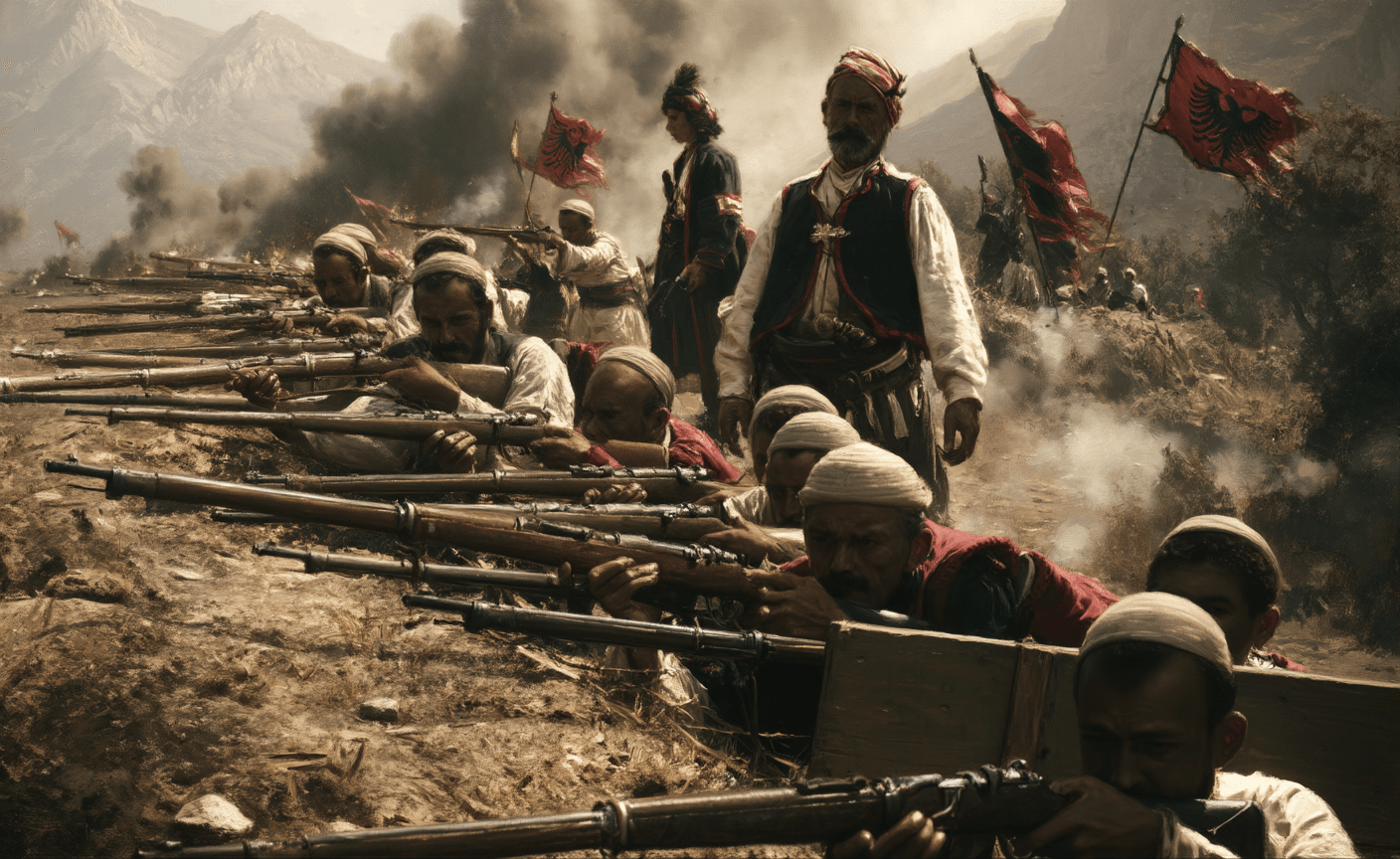
1200 Albanians VS 5400 serbs
In late October 1921, an estimated 5,400 Serbian troops pushed toward Lura, where Dibran and Lurian fighters under Elez Isufi stood against them at Qafa e Gëlqeres. Local historians call it "the last" battle, closing nine years of Dibran resistance.
In the autumn of 1921, 12 regiments of the Serbian army advanced into Albanian territory, shelling villages with heavy artillery before reaching the area near Lura on October 27. Their aim was to control a broad strategic line from which to pursue further objectives deeper into Albania. For years, Dibran forces led by Elez Isufi had stood in their way. Clashes between the Dibrans and the Serbian army had not stopped from 1912 to 1921, and the Dibrans convened an assembly at Arras on August 13, 1920, where a war staff was elected and Elez Isufi was named commander-in-chief.
Lura prepared according to its old traditions. Under the rule of "seven to seventy," males of every family from age seven to seventy could be mobilized. The council of elders ended disputes between families and forgave blood feuds, since, as they put it, they were facing the enemy. Bajraktar Hakik Mena, Selman Mena, Gjon Doqi and Ibrahim Gjoçi were named among the main leaders. Local accounts stress the unity of Catholics and Muslims, and describe volunteers whose rifles were of different models and whose cartridges often did not match them.
The first clashes came in the summer and September of 1921, at Kodëresh near Arras and at Kapra e Tereçit, both with heavy losses. The decisive fighting took place on October 26, 27 and above all Friday, October 28. Accounts put the Serbian force at about 5,400 troops with more than 30 artillery pieces carried by mules. The Albanian side had very few cannons, captured from Serbia in earlier fighting. Estimates of Albanian numbers vary, and one source gives about 1,200 fighters. The battle was meant to begin with a cannon shot near the church of Lura, but Hakik Mena and Ibrahim Gjoçi fired on the Serbian soldiers first.
Albanian fighters, with Elez Isufi at their head, struck the front line and attacked from the flanks and from behind, hitting artillery positions and command posts, while young men from nearby villages replaced the fallen. The order was firm: the Serbian troops must not cross Qafa e Gëlqeres. The fighting lasted for hours and at points became hand-to-hand. Abdullah Cara fell and Ramadan Prençi was wounded. According to the records, the Serbian army lost 615 soldiers in these parts from September to October 28, and it was driven back across the Drin.
In December 1921, the Serbian army decided to withdraw beyond the border set by the Conference of Ambassadors in London, and on December 8 it fully withdrew. Haki Sharofi's poem became the hymn of Dibran youth, and the historian Fatos Daci documented a list of those who fell between 1918 and 1921. On the 100th anniversary, the then president decreed Lura a "Honor of the Nation." Yet the battle is not mentioned in school textbooks, and researchers say many details remain to be uncovered, possibly in the Belgrade archives.