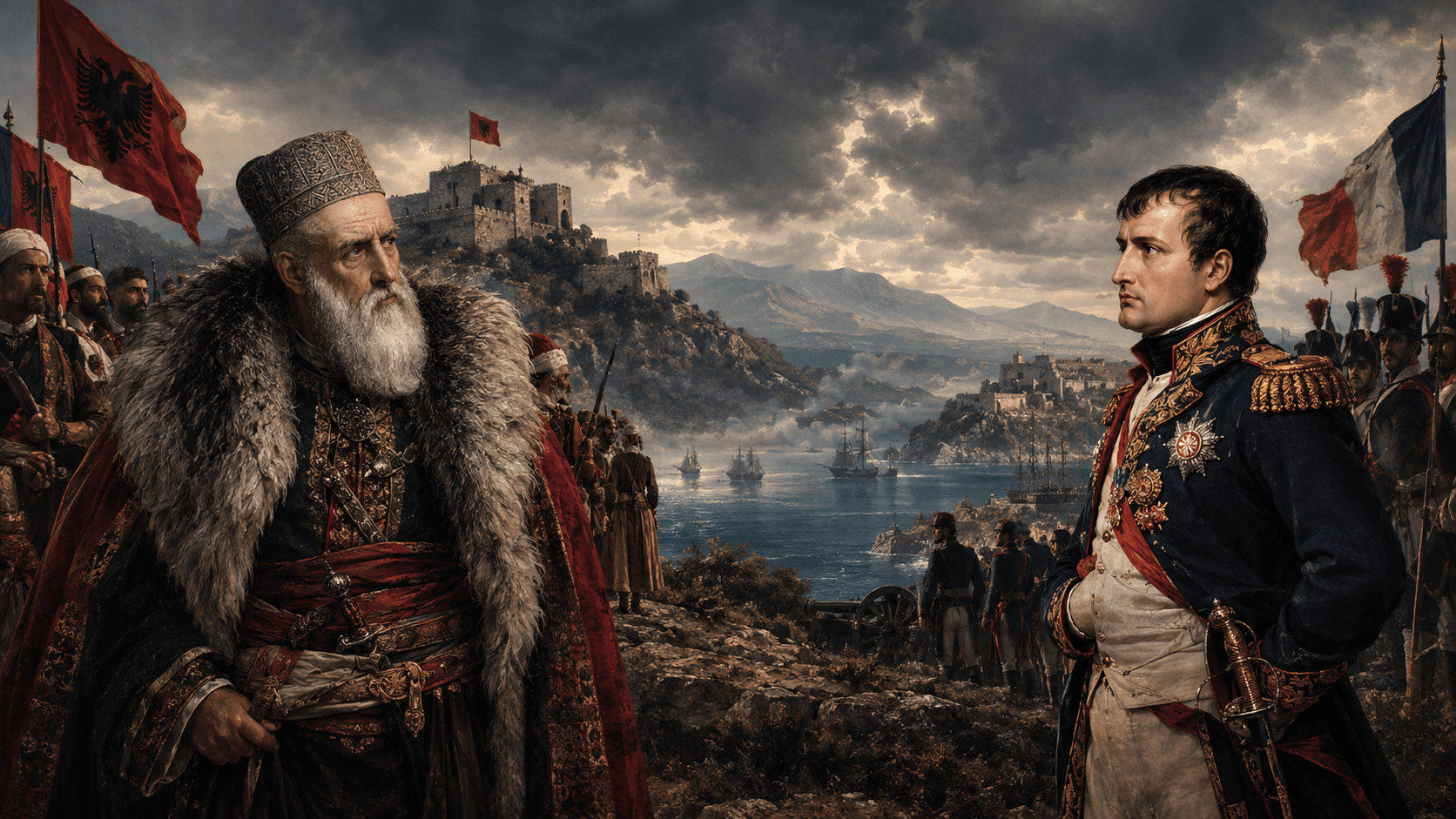
The Lion of Janina and the General: Ali Pasha's War Against Napoleon at Nicopolis
In October 1798, while Bonaparte's fleet burned at the Nile, Ali Pasha of Tepelena struck the French at Butrint and Preveza. It was the end of a courtship between two ambitious men, each hoping to use the other.
Ali Pasha was born in Beçisht, near Tepelena, and his father Velibey was killed while Ali was still a child. His mother was seized and humiliated, and the boy was left without protection, so banditry became his path. His gift for leadership won the favor of the authorities, and the sultan made him Pasha of Janina. From there he extended his rule over lands that today belong to Albania, Greece and North Macedonia. He built aqueducts, fortresses, bridges and roads, and Epirus became the cream of the Empire, so independent in fact that foreign diplomats called his domain Albania, though the Sublime Porte never recognized it.
Then Bonaparte arrived at his door. After the victories in Italy and the fall of the 1,100-year-old Venetian republic, Venice's possessions on the Ionian and Adriatic coasts passed to France. Butrint, Parga and Preveza were French, and Ali and Napoleon were neighbors. At first Ali received General Roze with the tricolor in his hands. The Frenchman married a girl from Ali's palace, and the officers were showered with gifts and supplies. Paris told General Gentili to favor the Pasha and to send engineers and staff officers to map Albania and learn all the intrigues that divided its peoples. Ali had his own price for friendship. When the Porte ordered him to Vidin against Pasvantoglu, a French ally, he demanded 10,000 French soldiers and a million francs. France refused, and Ali marched.
Each side was hiding its aims. Ali's network of agents told him that Butrint and Preveza were only a temporary station, and that the road to Constantinople ran through his pashalik. French agents courted local nobles to raise them against him. Ali, meanwhile, was reading the French plans through a woman in the general's own house. Zoica, the beauty from Janina whom Roze had married, kept him informed of every French move. Napoleon wrote a letter to Ali that never reached him. By then Ali stood at the walls of Vidin, and on 1 August 1798 the French fleet was destroyed by Nelson at the Nile. France looked weak, and Ali returned at once to Janina, put General Roze in shackles and sent him to Istanbul. On 18 October he attacked Butrint.
Butrint fell after fierce fighting, and the survivors fell back on Preveza, where General Lasalcette had drawn up some 440 Frenchmen and 260 natives, Suliots among them, on the isthmus at the ruins of Nicopolis. Richemont, a master of fortifications and artillery at only 27, dug trenches from one shore to the other and set cannons in two fortifications. Ali came with about 4,000 infantry and 3,000 cavalry. At midnight his son Myftar Pasha struck with 500 Albanians, and Kristaqi and a number of Preveza volunteers abandoned the line. The French counterattacked at dawn but lost Lieutenant Leroy. At eight Ali himself arrived and his army poured down from the hills of Mihalisi. At ten the cavalry broke the center, and Richemont's grapeshot slaughtered Myftar's men but could not turn the day. Richemont dismounted his guns and crossed the field alone, killing six horsemen with musket and bayonet. Twenty riders closed on him, and he was dragged by the hair toward the block until Hasan Çapari spared his life. Ali, admiring his courage, ordered him respected.
Captain Tisot gathered 80 grenadiers and tried to rescue Lasalcette, but the Albanian infantry stopped him. He withdrew in order, and the Albanians let the fugitives go and marched on Preveza. Allies opened the gates of Saint Andrew. The French garrison fell, and Tisot's grenadiers held the port with their backs to the sea while about 1,000 Prevezans escaped. The last French ship sailed, and Tisot refused a place on a local's boat. His men made their last stand in the church of Saint Haralambos, and after two and a half hours the survivors were taken. Ali arrived and stopped the plundering. Lasalcette, Richemont and Tisot were marched through Janina in a triumph and sent to the sultan as a sign of loyalty. In Yedikule they met the writer Pouqueville, who recorded the battle.
The victory did not bring Ali the power he hoped for. The agreement of 1800, which founded the Septinsular Republic, put the cities he had taken into the hands of the Porte, and Ali received only some posts of honor. Of all the places he conquered, Preveza was the one he kept. The man who had humbled Napoleon's soldiers now faced the Sublime Porte, and the road led toward his final clash with it.