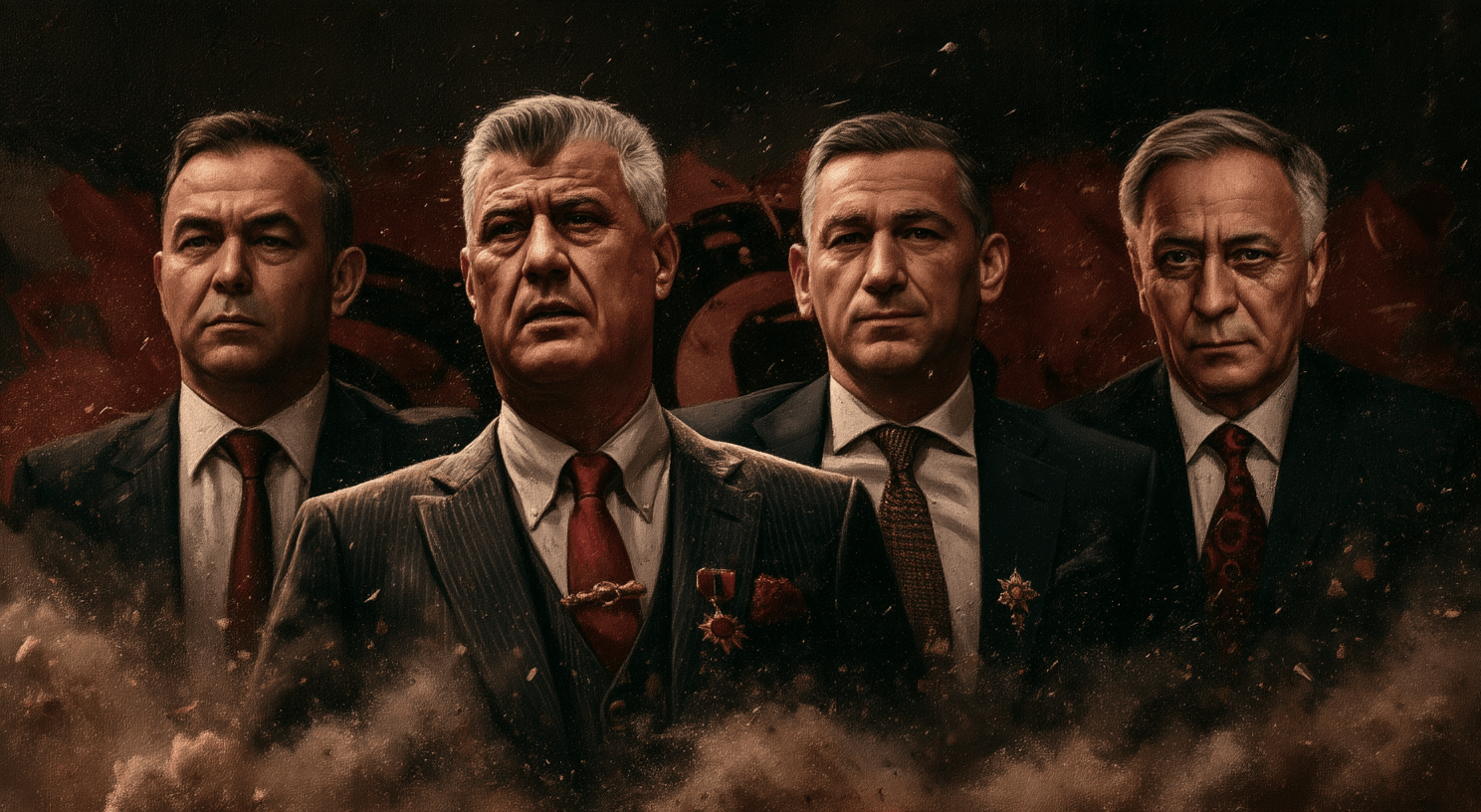
The Verdict in The Hague: Four Men Sentenced, a Nation on Trial
Thaçi, Krasniqi, Veseli and Selimi have been sentenced in The Hague, yet the court rejected the charge that would have condemned the whole KLA war. The real test now is whether Kosovo can reconcile at home and hold fast to the West.
The sentences were read out in a few flat sentences. Hashim Thaçi, 25 years. Jakup Krasniqi, 25 years. Kadri Veseli, 18 years. Rexhep Selimi, 13 years. Then the session was adjourned and everyone rose. For those who fought, and for the many who died for freedom, it was a heavy stain on the international legal system, and a tragedy to see men who represented thousands of Albanians declared guilty without proof.
Yet the verdict did not include crimes against humanity. All six counts were dismissed, because the court found that the attacks were aimed at individuals and not at a wider population. Crimes against humanity imply a program, a predetermined plan to harm or exterminate a population. Had that conviction come, the collective blame of the KLA's war, and of the Albanian nation's struggle to free itself from genocide, would have been complete. The court rejected it. There was no plan, no systematicity, and not enough crimes after 20 June 1999 to keep the charge standing.
The road to The Hague began with a shadow. Carla Del Ponte, former prosecutor of the International Criminal Tribunal for the former Yugoslavia, threw out the claim that KLA members had detained people and sent them to Albania, where their organs were suspected of being removed. The Council of Europe sent the Swiss senator Dick Marty, a former prosecutor and aide of Del Ponte, who in December 2010 presented a report with a bombastic title on organ trafficking and the so-called Yellow House. The report was unsupported by evidence. The EU task force under John Clint Williamson spent three years and found no evidence of massive or widespread organ trafficking. It was a monstrous accusation, the same one once leveled at the Croats and at Bernard Kouchner, and it was set in motion by Serbia, the loser of the Kosovo conflict, which had collided with the West and activated it internationally with Russia's help. It is the old technique of the initiator of every war at the end of the 20th century: smear the opponent and transfer the blame.
On 26 June 2015 the Assembly of Kosovo rejected the constitutional amendments for the Specialist Chambers, but under great international pressure it gave in, and the green light came on 3 August. Albin Kurti was among the strongest critical voices, warning the deputies to the very end of the legal and political consequences. Rexhep Selimi pleaded that the resolution was against the independence of Kosovo and that they would all regret it someday, when it would be too late. Thaçi appeared relaxed, believing he would never end up there. A third path existed, a court on Kosovo's own soil with EULEX judges and prosecutors, fully within the sovereignty of a state that had just won the International Court of Justice's acceptance of its declaration of independence. It could have succeeded.
Now Serbia pockets a bonus. Because the four were a former president, prime minister, speaker of parliament and opposition leader, the world's media wrote: former president of Kosovo sentenced for war crimes. Serbia's aim is to paint the whole war and the new state as the work of a criminal organization. Still, the West has reconfirmed its support for Kosovo's statehood. Of the 5,000 testimonies the court relied on, 2,300 came from Serbian prosecution or security sources and 2,700 from Albanians themselves, which shows that Kosovo needs reconciliation between those who fought and those who did not, as Ibrahim Rugova understood when he brought the people of the war into government. Four lines must guide the nation: reconciliation, a rigorous legal review of the first-instance mistakes, a broad-based government, and stronger ties with the West. To equate the Specialist Chambers with the West is the worst own goal. The West helped Kosovo to statehood in unique, unrepeatable circumstances, and Kosovo must not give Serbia room to normalize its relations with it. Almost three decades after the West intervened to end the atrocities and ethnic cleansing of the Albanians, perhaps the time has come to remind it of the commitment it made then.