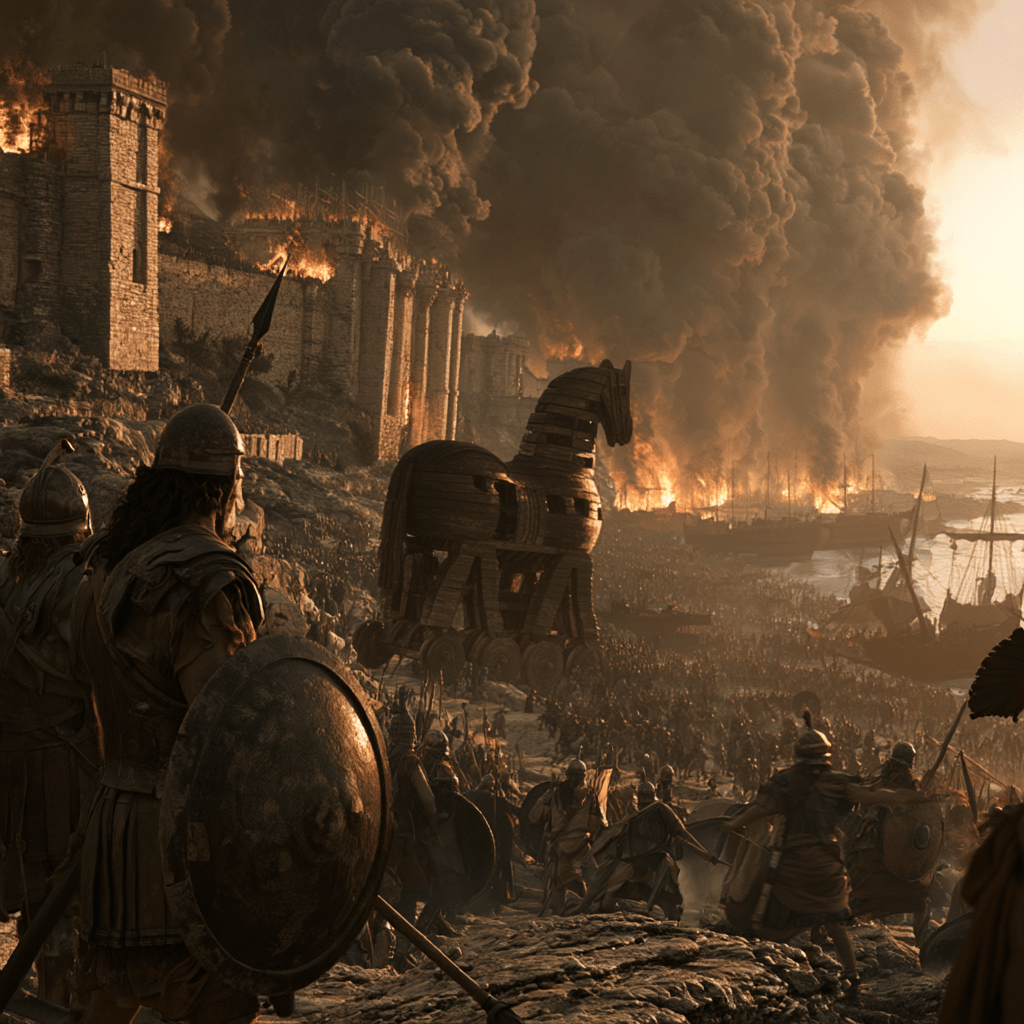
The Trojan War: A Clash Between the Ancestors of the Albanians
Strip away the word "Greek" that later translators pasted over the ancient texts, and the war of Troy looks like a struggle between kin. Both camps were Pelasgian and Illyrian, and their language, laws and rites still echo in Albanian.
The war of Troy was a world war. Three continents were drawn into a conflict that lasted more than ten years, and Achilles himself told Priam at Hector's grave that the real question was who would rule the world. The abduction of Helen was only the excuse for plundering rich Troy. The true cause lay decades earlier, when Hercules and the Argonauts under Jason came to Phrygia and Laomedon ordered them off his shores. Hercules never forgave the insult. He returned with Castor, Pollux, Telamon, Peleus and Nestor, besieged Troy, broke its walls, killed Laomedon and gave his daughter Hesione to Telamon as a prize. Priam rebuilt the walls and sent Antenor to demand her back. When he was turned away, Paris sailed to Menelaus, and Helen left with him by night. Roughly fourteen hundred ships later, the war began.
The ancient texts never spoke of Greeks. Homer's fighters are Argives, Danaans and Achaeans, and Ovid, Statius and Seneca call the same men Pelasgians. Calchas cries out, "Pelasgian men, we shall conquer," and Ajax addresses his own people as Pelasgians. The word Greek came hundreds of years after the war, yet later translators erased the original names and wrote Greek or Hellene in their place. As Elena Kocaqi shows, this distorted the historical truth. Restore the names, and the Trojans appear as Pelasgians too. Priam was a Dardanian, descended from Dardanus, and Diodorus tells us that the Dardani who live beyond Thrace, the Albanians of present-day Kosovo, were colonists sent out by him. Hittite and Egyptian records place the Dardanians and the land of Wilusa, the Hittite echo of Ilios, in Asia Minor.
The Phrygians who made up most of Troy's population were the Brygi, who left the Illyrian lands long before the war. Strabo places them in central Albania near Durrës, and Herodotus says that when the Briges crossed to Asia they became Phrygians. The Achaean royal house came from Pelops, a Phrygian and son of Tantalus, who crossed to the Peloponnese and won Olympia's chariot race, the root of the Olympic games. Both camps knew they were kin, and in all the dialogues between Achaeans and Trojans no interpreter is ever needed. The Phrygian words preserved by Plato and Herodotus survive in Albanian today: udor for water, kunes for dog, becos for bread, echoed in bukë. Nothing in ancient or modern records shows the Albanians arriving from elsewhere. Pelasgians, Illyrians, Dardanians and Brygians all went out from the same land, and that makes the Albanians autochthonous, with a language among the oldest in the world.
The Kanun shows the same bond. Hospitality is sacred in both worlds. The Kanun says the Albanian's home belongs to God and the guest, and the Trojans could not give up Helen because she had come under their protection. Ulysses warned that breaking the law would spread like a plague: friend would fear friend, and no one would open his door even to a brother. Achilles feasted Priam and returned Hector's body, as the Kanun obliges a host to welcome an enemy. Blood money, the double blood feud for defiling a corpse, and the shame of stripping a slain man's armor all appear in the Iliad and in the Kanun. Helen herself, asked before the council whether she wished to go home, answered no, and by the Kanun she became answerable to her husband, yet the guest law shielded her.
The mourning of Hector, with weeping, torn hair and scratched faces, and the grief at the pyre of Achilles live on in the Gjama e Burrave, the lament of men, and the Vajet e Grave, the mourning of women. Barleti saw Lekë Dukagjini lament Skanderbeg this way, Budi and Bardhi described the rite, and in 1937 Reimer Schulz watched twelve men in Theth keen over their dead in a ritual as old as the Pelasgians. The survivors of Troy carried this heritage outward. Aeneas sailed west and his line shaped Rome, Antenor reached the Adriatic and the land of the Veneti, and Neoptolemus burned his ships and marched into Epirus, where Helenus and Andromache ruled at Buthrotum and Molossus founded the dynasty that would give the world Pyrrhus and Alexander. The conclusion is plain: the Albanians descend from these ancient tribes, and this story deserves far deeper study.