Without Arvanites, There Is No Greece
Long before they were called Arvanites, they were the Arbëror, a people of the same land, language and blood as the Albanians. This is the story of the warriors who rose in 1821 and of the identity they were made to surrender.
Before the Arvanites, there were the Arbëror. Their name changed over the centuries and appears as Albanoi, Arbanitis, Albanezi and more, yet it always points to the same geography, the same language and the same Albanian descent. Hecataeus of Miletus first recorded the Abroi near the Taulanti and the Enchelei, and Stephanus of Byzantium later wrote of the city of Arbon in Illyria, whose people were the Arbonitis. In the Byzantine tongue Arbonitis became Arvanitis. The ancient city of Zgërdhesh near Kruja marks the same soil, and modern genetic studies trace the Albanians back to the Illyrians and Pelasgians. The only thing separating Arvanitica from standard Albanian is the old divide of northern Gheg and southern Tosk.
The Arbëror did not leave their lands willingly. Four waves pushed them south and west: Byzantine emperors who crushed their uprisings between the 10th and 14th centuries, the Angevins and then the Venetians, the invasion of Stefan Dushan in the 1340s, and finally the Ottomans in Epirus. Soldiering was their trade. As Stratiotes they served Byzantium and Venice, drew a roga, and in time became lords and dukes or received lands to settle. They carried their family names with them, and Mati, Spata, Klementi, Mallakasa and Kryekuqi still mark the map of Greece. Ottoman records later showed the Arbëror dominating Janina, Thessaly, Arta, Euboea, Athens, Corinth, the Peloponnese and even Crete. Those who fled Morea for Italy became the Arbëresh, and they still sing Moj e Bukura More, a song that is not about a beautiful girl but about a homeland they were never allowed to see again.
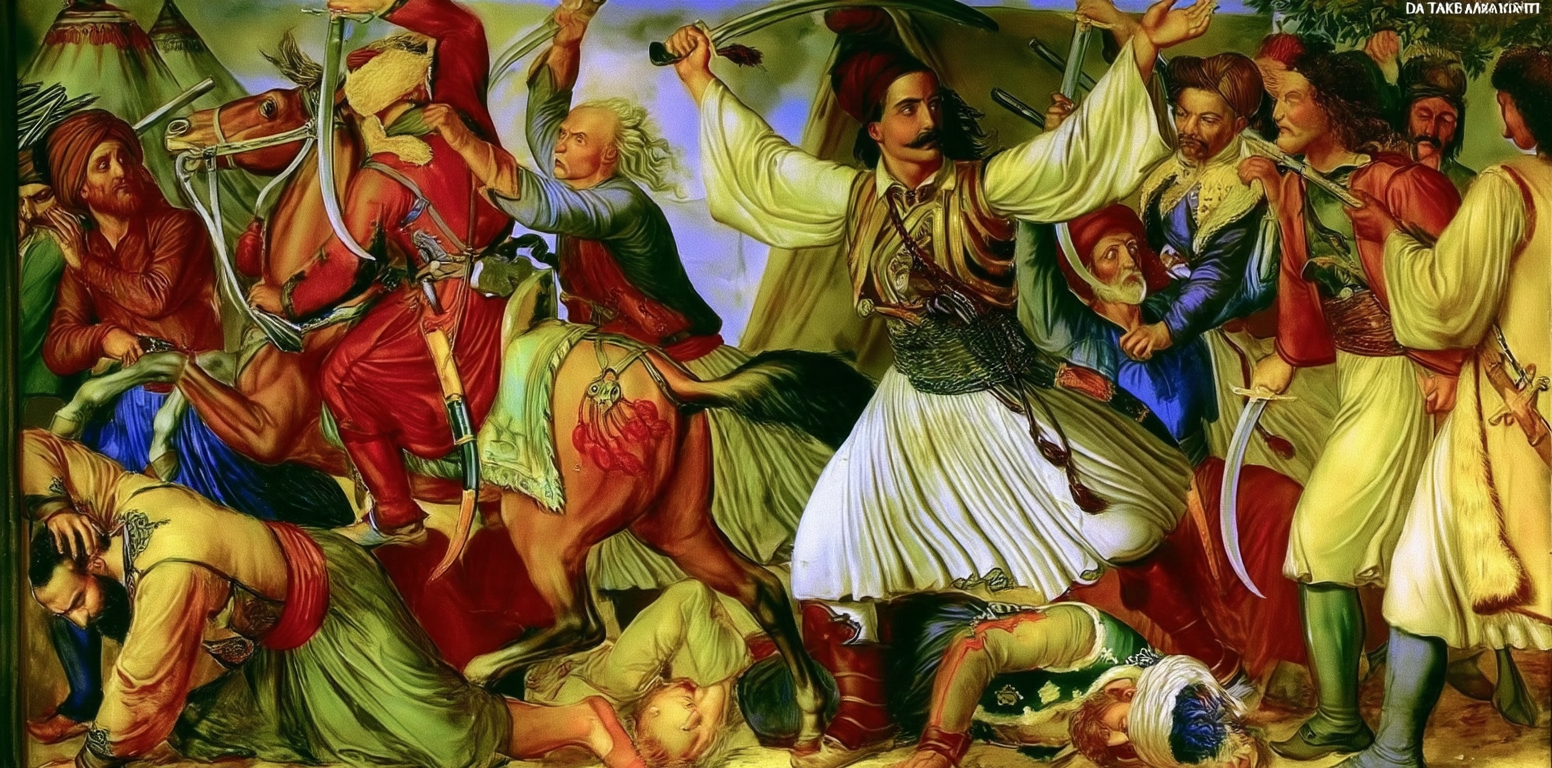
The travelers who came to Greece expecting heirs of Plato and Sparta in tunics found something else. They found Albanians, Romiots, Vlachs, Arabs, Slavs and Jews, and most of these people could not speak Greek. John Cam Hobhouse wrote in 1810 that Albanians formed almost the whole population of Attica, with villages near Athens where Greek was hardly understood. François Pouqueville saw in the people of Epirus the soldiers of Alexander, Pyrrhus and Scanderbeg. John Philip Morier described men with the ferocity of Spartans, in sandals and a tunic-like dress. That dress was the fustanella, from the Albanian word fustan, a white kilt carved in stone since the Illyrian age. The Ottomans called Albanians the Fustanella Warriors, a name given to no other Balkan people. Delacroix, Gérôme and Beresford painted it, and Lord Byron bought one and called the Albanians in their dress the most magnificent in the world. A shorter version is now the national dress worn by the Greek Royal Guard.
When the uprising began in 1821, the heroes at its head were Arvanites. Of the hundred heroes of the revolution, ninety were Arvanites. Nikolaos Kriezotis came from Karistas in Euboea and Athanasiou Skurtanioti from Shkurta in Boeotia. Andreas Miaoulis and Laskarina Bouboulina were born on Hydra, Theodoros Kolokotronis was born to the old name Çergjini, and Odysseas Androutsos came from Preveza in Çamëria. Kitsos Tzavelas and Markos Botsaris came from Souli, where Skanderbeg's soldiers were said to have settled to escape slavery. V.M. Leake wrote that the Souliots came from Chameria, one of the four branches of the Albanian population, and Cipollini wrote that they did not know Greek at all. Botsaris fell on 9 August 1823 and, as the legend goes, sighed his last words in Albanian, leaving his killer Lleshi i Zi stunned and asking whether he too was Albanian. In 1832 the house of Noti Bocari was burned and with it the archive of the Botsaris tribe, an archive that proved the Arvanites and Souliots were sons of Albania.
What followed was a long erasure. The great powers, whose navies won at Navarino in 1827, shaped the new state, and Prince Otto of Bavaria arrived to find a land full of Arvanites and set about assimilating them through seduction and through violence. After the Balkan Wars of 1912-1913 Çamëria, with over 70,000 Arvanites by Ottoman count in 1910, was absorbed into Greece, and a campaign of expulsion and killing began. The Lausanne Convention of 1923 exchanged more than 500,000 Muslims, mostly Albanians, while alien settlers were placed on their lands to stop their return. In the Second World War thousands of Çamëria's Albanians were massacred by the forces of Napoleon Zervas. Orthodox Arvanites who stayed were taught that to be Albanian was to be lowly and to be Greek was to prosper. Yet Greek history cannot make sense without them, because without Arvanites there is no Greece, and without Greece there are no Arvanites. The Albanians are an ancient autochthonous people, and their language, songs, tales and blood will live on.